Our Founder
John Robert Crouse, Sr. (January 1, 1874 – July 1946) — industrialist, humanitarian, and the man behind the Hartland Area Project that built this Hall.
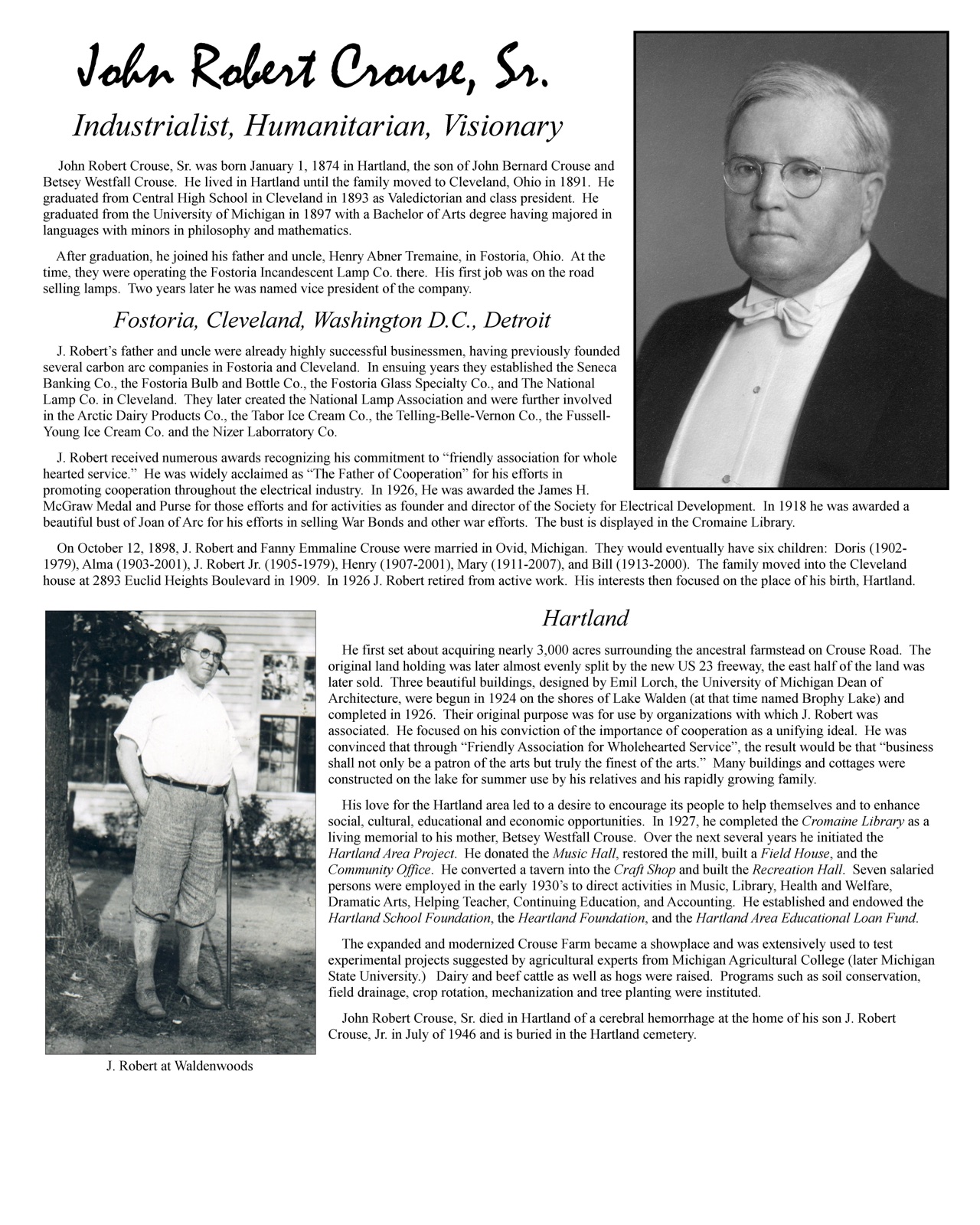
A family-prepared biography of the founder, on display in the Hall.
From Hartland to industry
John Robert Crouse, Sr. was born in Hartland on January 1, 1874, the son of John Bernard Crouse and Betsey Westfall Crouse. The family moved to Cleveland in 1891. He graduated valedictorian and class president from Central High School in Cleveland in 1893, then earned a Bachelor of Arts from the University of Michigan in 1897, majoring in languages with minors in philosophy and mathematics.
After graduation he joined his father and his uncle, Henry Abner Tremaine, at the Fostoria Incandescent Lamp Co. in Fostoria, Ohio — starting on the road selling lamps, and named vice president within two years. The family's businesses grew to include several carbon arc companies, the Seneca Banking Co., the Fostoria Bulb and Bottle Co., the Fostoria Glass Specialty Co., and the National Lamp Co. of Cleveland, among others.
He was widely acclaimed as “The Father of Cooperation” for his efforts promoting cooperation throughout the electrical industry, and in 1926 received the James H. McGraw Medal and Purse for that work and for founding and directing the Society for Electrical Development. In 1918 he was awarded a bust of Joan of Arc for his efforts selling war bonds — still displayed today in the Cromaine Library. He married Fanny Emmaline Crouse on October 12, 1898, in Ovid, Michigan; together they raised six children.
Coming home to Hartland
Mr. Crouse retired from active business in 1926 and turned his attention to his birthplace. He began acquiring nearly 3,000 acres surrounding his family's ancestral farmstead on Crouse Road — land later split by the new US-23 freeway. On the shores of Lake Walden (then known as Brophy Lake), he commissioned Emil Lorch, dean of the University of Michigan School of Architecture, to design three buildings, begun in 1924 and completed in 1926 — the seed of what became Waldenwoods.
In 1927 he completed the Cromaine Library as a living memorial to his mother, Betsey Westfall Crouse. He launched the wider effort with a statement that still hangs in this Hall today:
“I will be dealing with folks I love. I was born in Hartland, I will perchance die there, I shall be buried there and I am going to try to work out my last dream there.”
The Hartland Area Project
He called the effort the Hartland Area Project — built on his conviction that “business shall not only be a patron of the arts but truly the finest of the arts,” guided by his motto, “Friendly Association for Wholehearted Service.” Over the following years he donated the Music Hall, restored the mill, built a Field House and a Community Office, converted a tavern into the Craft Shop, and built a Recreation Hall. By the early 1930s, seven salaried staff directed activities in Music, Library, Health and Welfare, Dramatic Arts, Helping Teacher services, Continuing Education, and Accounting.
To fund and sustain that work, he established three charitable trusts:
- The Hartland Consolidated Schools Foundation (December 13, 1928, $25,000)
- The Heartland Foundation (August 14, 1929, $100,000 — established with his uncle, Henry Abner Tremaine)
- The Hartland Area Educational Loans and Prizes Trust (March 2, 1942, $18,010.03), which helped area students further their education through loans
The expanded Crouse Farm itself became a showplace, hosting experimental agricultural programs with Michigan Agricultural College (later Michigan State University) in soil conservation, field drainage, crop rotation, and mechanization.
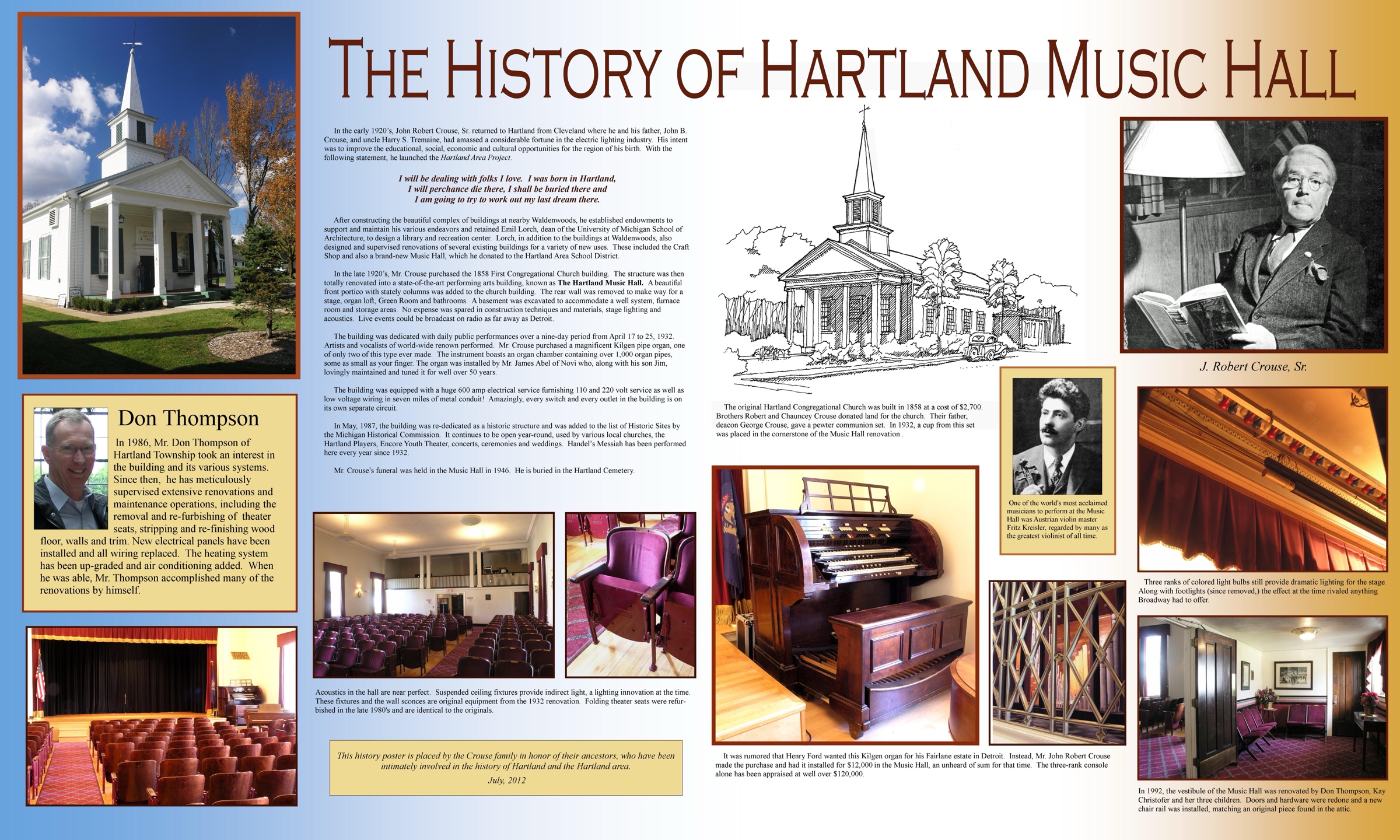
The history marker on display in the Hall, placed by the Crouse family in honor of their ancestors, July 2012.
The Music Hall you're standing in
The building itself predates the Project by decades. The original Hartland Congregational Church was built in 1858 at a cost of $2,700 — brothers Robert and Chauncey Crouse donated the land, and their father, deacon George Crouse, gave the church a pewter communion set. In 1932, a cup from that very set was placed in the cornerstone of the Music Hall renovation, tying the building's two lives together.
In the late 1920s, Mr. Crouse purchased the 1858 church building and had it totally renovated into a state-of-the-art performing arts building — The Hartland Music Hall. The rear wall was removed for a stage, organ loft, Green Room, and bathrooms; a basement was excavated for a well system, furnace room, and storage. No expense was spared: the building was wired with a 600-amp electrical service and seven miles of low-voltage conduit, every switch and outlet on its own circuit, and live events could be broadcast on radio as far as Detroit.
The Hall was dedicated with daily public performances over nine days, April 17–25, 1932, featuring artists and vocalists of world renown — among them the Austrian violinist Fritz Kreisler, regarded by many as the greatest violinist of all time. Mr. Crouse purchased a magnificent Kilgen pipe organ for the occasion — one of only two of its kind ever made, with over 1,000 pipes, some no larger than a finger. It was rumored Henry Ford wanted the same organ for his Fairlane estate in Detroit; Mr. Crouse had it installed here instead, for the then-unheard-of sum of $12,000. Three ranks of colored stage lights, still in use today, once rivaled anything Broadway had to offer.
Foundation board minutes from 1930 through 1958 show that keeping this building running — utilities, insurance, seat repair, the organ, stage lighting, student music programs, and an annual presentation of Handel's Messiahevery year since 1932 — was the Hartland Consolidated Schools Foundation's central, recurring work. In May 1987, the Hall was re-dedicated as a historic structure and added to the list of Historic Sites by the Michigan Historical Commission.
A family legacy, still active today
Mr. Crouse died in Hartland of a cerebral hemorrhage in July 1946, at the home of his son J. Robert Crouse, Jr. His funeral was held in this Music Hall, and he is buried in the Hartland Cemetery. J. Robert Jr. (1905–1979) carried the Project forward through the 1950s and '60s, working to bring the community closer to its institutions and to keep the founding mission current. Beginning in 1986, Hartland Township resident Don Thompson took a personal interest in the Hall, meticulously supervising decades of renovation and maintenance — refurbishing the theater seats, stripping and refinishing the woodwork, replacing electrical panels and wiring, and upgrading heat and air conditioning, much of it by his own hand.
The Crouse family's stewardship continues today through Waldenwoods — the retreat Mr. Crouse founded on Lake Walden, which once hosted guests including Henry Ford, Thomas Edison, and Harvey Firestone, and is now home to Frank and Brian Crouse's work building an unparalleled residential community around that same historic resort.
“Days and nights alike at Waldenwoods speak the mystic language of nature in her loveliest mood. We hope you find here all the joy and happiness that we have.” — J. Robert Crouse
One organization again: Hartland Area Project, Inc.
Mr. Crouse never intended his three foundations to run as separate, disconnected funds — they were always meant to serve one common purpose, together. But over the decades since, each was administered on its own, by its own trustee and its own board, gradually drifting apart from the unified “Friendly Association for Community Service” he'd set out to build.
Today, Hartland Area Project, Inc.— a nonprofit recognized by the IRS as a 501(c)(3) in 2019 — is bringing that original vision back together. It is taking shape as the operating hub that draws the historic foundations back under one roof, organized around the same three aims the founder pursued from the start: health and welfare, education and culture, and economic development in the Hartland community. The J. Robert Crouse Memorial Scholarship carries his name forward for today's students as one of its programs.
It is, in effect, the founder's century-old idea finally reunited under a single organization — closer to what J. Robert Crouse first set out to build than the Project has been in decades.
Why our assistant carries his name
The Hall's AI concierge, Maestro J. Robert, is named in his honor — a small, ongoing nod to the man whose “Friendly Association for Community Service” built the education system, library, and music hall Hartland still enjoys today.